Gaussian
A Gaussian plume according to Chat GPT is
In atmospheric science and air pollution modeling, a Gaussian plume is a commonly used mathematical model to describe the dispersion of pollutants emitted from a point source into the atmosphere. The model is based on the Gaussian distribution, also known as the normal distribution.

Here are the key points about Gaussian plumes:

1. Point Source Emission: The Gaussian plume model assumes that the pollutant is emitted from a single point source, such as a chimney or stack.

2. Dispersion: As the pollutant is emitted, it disperses in the atmosphere due to various factors such as wind speed, atmospheric stability, turbulence, and diffusion.

3. Gaussian Distribution: The dispersion of pollutants in the atmosphere is represented by the Gaussian distribution, which is a bell-shaped curve. This distribution describes the probability of finding pollutant concentrations at different distances and heights from the source.

4. Plume Shape: The Gaussian plume model predicts that the pollutant concentrations decrease with distance from the source and follow a characteristic plume shape. Near the source, the plume is narrow and concentrated, while it spreads out and becomes more diluted as it travels further away.

5. Dispersion Parameters: The model involves parameters such as the emission rate, atmospheric stability, wind speed, atmospheric turbulence, and the height of the stack to calculate the pollutant concentration at different locations.

6. Limitations: The Gaussian plume model is a simplification of the real-world atmospheric dispersion process, and it has certain limitations. It assumes steady-state conditions and does not consider complex terrain, buildings, or other obstructions that could significantly influence the dispersion pattern.

7. Application: Despite its limitations, the Gaussian plume model is widely used due to its simplicity and computational efficiency. It is commonly applied in environmental impact assessments, air quality studies, and regulatory compliance assessments to estimate the impact of emissions from industrial facilities, power plants, and other sources.
Chama Gaussian Plumes
From the chama docs site
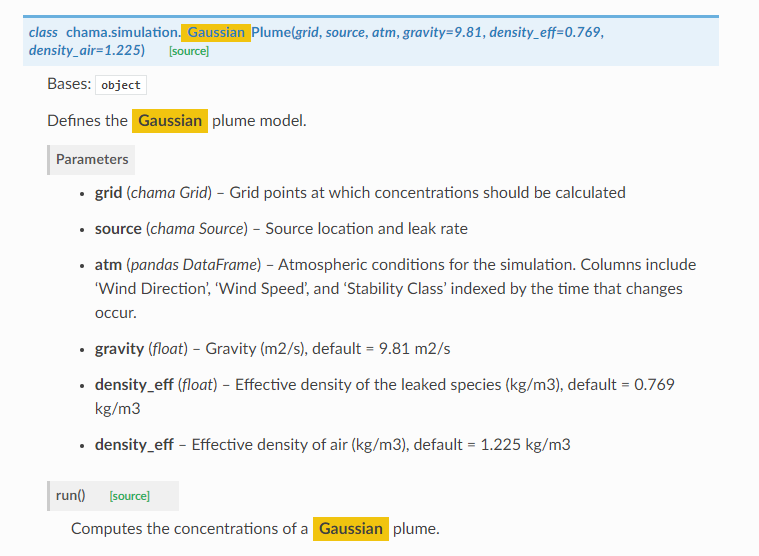
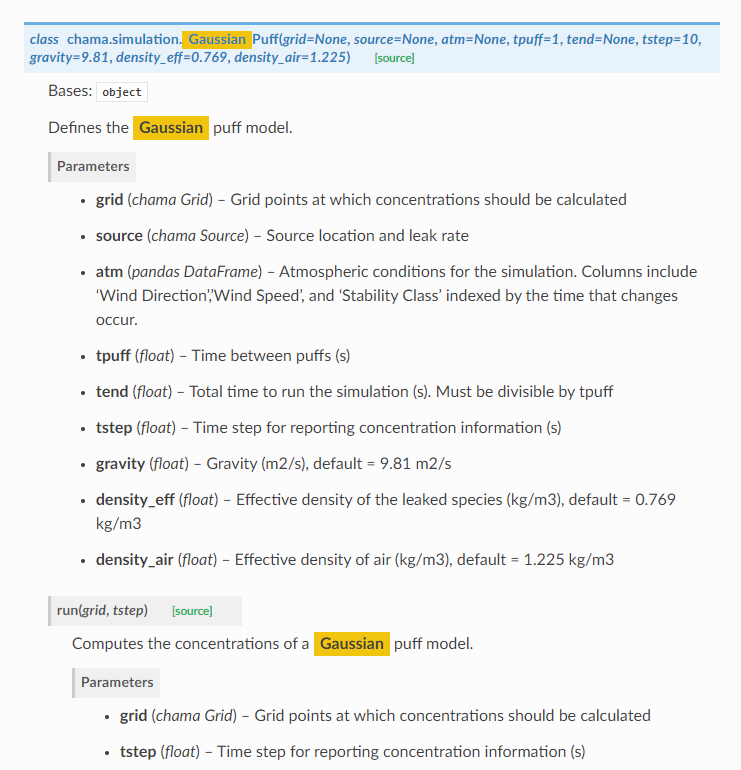
Chama includes methods to run simple Gaussian plume and Gaussian puff atmospheric dispersion models [Arya99]. Both models assume that atmospheric dispersion follows a Gaussian distribution. Gaussian plume models are typically used to model steady state plumes, while Gaussian puff models are used to model non-continuous sources. The chama.simulation module has additional information on running the Gaussian plume and Gaussian puff models. Note that many atmospheric dispersion applications require more sophisticated models.
Gaussian Plume
Gaussian Puff
Architecture issues
The current architecture of Chama is that we Create the INP file and run PySwmm. This gives us a signal file that we run in chama.
In order to run Chama Gaussian Plume we would need to do the following:
- Set up the inputs for Gaussian Plume on Chama.
- Run the Gaussian Plume.
- According to documentation we should get concentration values back. Hopefully, The concentration points can easily be assigned to subcatchments.
- Put the concentration into the INP file.
- Run PySWMM. To generate Signal file.
- Combine Signal file with other signal files.
- Run Chama and execute simulation.
Input Issues
- grid - This should be subcatchments.
- source - should be randomized subcatchment.
- atm - Pandas data frame with atmospheric conditions. No Idea where this information would be.
- Wind direction
- Wind Speed
- Stability index
- gravity - default should be good right?
- density_eff (float) - density of the pollutant. We will need to get this from EPA or something.
- density_eff - density of air. The default should be good but would pollutant levels in somewhere populated like LA or over half the country having bad air quality due to wild fires effect the simulation?